personality-tests
Combining Cognitive Ability and Personality Assessments: A Guide for Hiring
Explore how combining cognitive ability and personality assessments can enhance hiring accuracy, ensure fairness, and improve outcomes.
Quick answer
How can combining cognitive ability and personality assessments improve hiring?
Combining these assessments creates a multi-signal battery that improves predictive validity, reduces turnover, and enhances fairness.
Source: Research Brief
Executive Summary
Combining cognitive ability and personality assessments in hiring processes leads to better outcomes. These multi-signal assessment batteries provide a more comprehensive view of a candidate's potential, improving predictive validity and fairness.
The bottom line: Combining these assessments can boost hiring accuracy to a validity coefficient of 0.65 and reduce turnover by up to 50%.
Critical Warning: Always validate assessments across demographic groups to ensure fairness and legal compliance.
What Are Cognitive Ability and Personality Assessments?
Cognitive Ability Tests:
- Measures: Problem-solving, reasoning, learning capacity.
- Predictive Validity: 0.51–0.58.
- Best For: Complex roles, technical positions.
Personality Assessments:
- Measures: Motivation, work style, interpersonal fit.
- Adds Incremental Validity: Beyond cognitive tests.
- Best For: Sales, team-based, creative roles.
| Dimension | Cognitive Ability Tests | Personality Assessments |
|---|---|---|
| What It Measures | Problem-solving, reasoning | Motivation, work style |
| Predictive Validity | 0.51–0.58 | Varies; adds validity |
| Best For | Technical roles | Creative roles |
Why Combine These Assessments?
Combining cognitive and personality assessments creates a more holistic view of candidates, capturing different dimensions of job performance.
Benefits:
- Increased Predictive Validity: From 0.51 to 0.65.
- Reduced Turnover: By up to 50%.
- Enhanced Fairness: By reducing demographic bias.
| Combination | Predictive Validity | Turnover Reduction |
|---|---|---|
| Cognitive Only | 0.51 | Baseline |
| Cognitive + Personality | 0.65 | Up to 50% |
How to Design an Optimal Assessment Battery
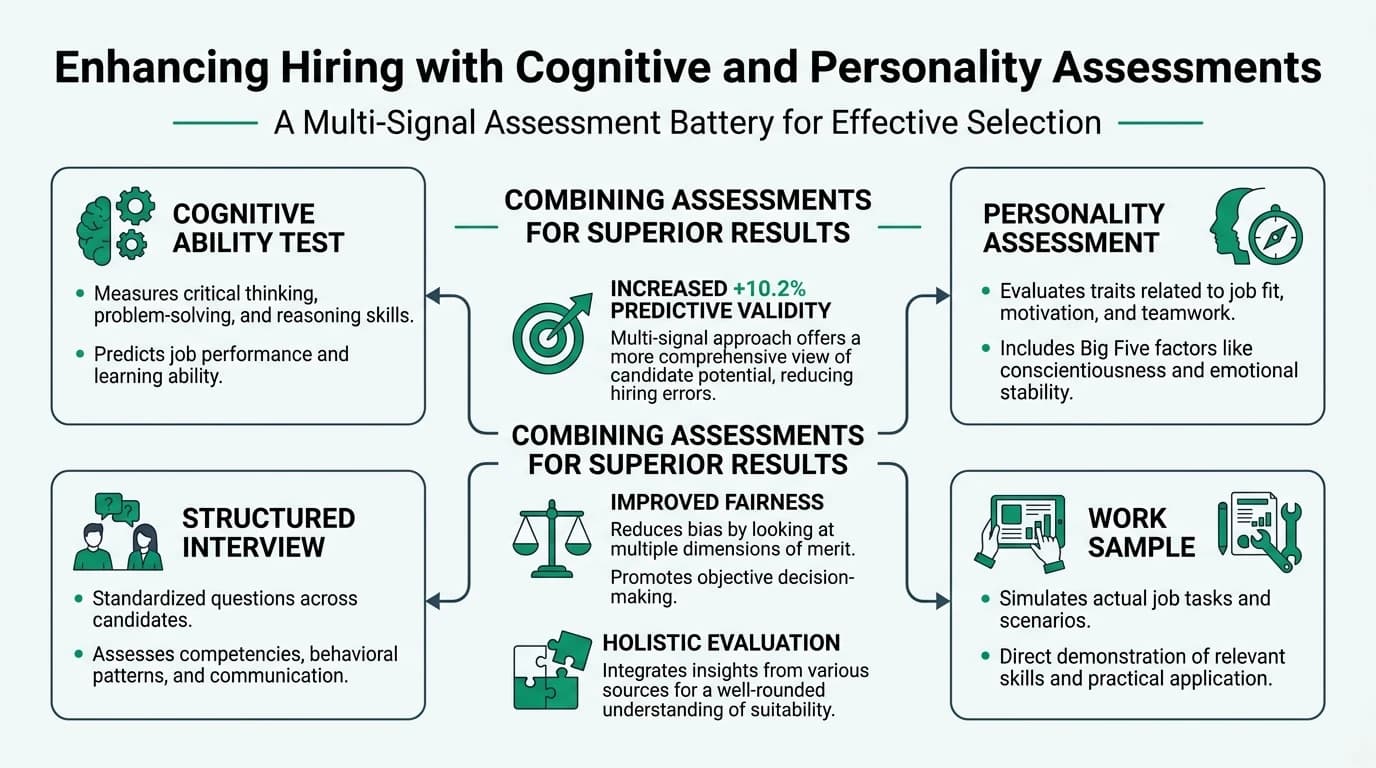
An optimal assessment battery includes multiple signals to capture a broad range of candidate qualities.
Components:
- Cognitive Ability Test: Measures reasoning and problem-solving.
- Personality Assessment: Adds insight into motivation and fit.
- Structured Interview: Evaluates interpersonal skills.
- Work Sample: Assesses practical job-related skills.
| Battery Composition | Predictive Validity | Variance Explained |
|---|---|---|
| Four-signal (Cognitive + Personality + Interview + Work Sample) | Highest | Optimal |
Ensuring Fairness and Reducing Bias
To maintain fairness, validate assessments across different demographic groups and monitor outcomes continuously.
Fairness Strategies:
- Criterion-related Validity: Ensure assessments are job-relevant.
- Bias Audits: Regularly analyze score distributions.
- Ongoing Monitoring: Track performance outcomes by group.
| Validation Element | Purpose | Risk if Skipped |
|---|---|---|
| Criterion-related validity | Ensure relevance | Legal liability |
| Bias audit | Mitigate demographic differences | Discrimination risk |
Role-Specific Assessment Strategies
Tailor assessment batteries to the specific needs of each role.
Examples:
- Tech Roles: Emphasize cognitive ability and technical skills.
- Sales Roles: Focus on personality traits like openness and agreeableness.
- Creative Roles: Weight personality (openness) more heavily.
| Job Category | Primary Assessment | Secondary Assessment |
|---|---|---|
| Software Engineer | Cognitive | Technical work sample |
| Sales Representative | Personality | Cognitive |
Measuring ROI and Outcomes
Implementing a multi-signal assessment battery can significantly improve hiring outcomes.
Key Metrics:
- Top Performer Identification: 85% accuracy with cognitive + structured interview.
- Turnover Reduction: Up to 50% with multi-signal approach.
| Outcome | Improvement |
|---|---|
| Top Performer ID | 85% accuracy |
| Turnover Reduction | Up to 50% |
Action checklist
- Validate assessments across demographic groups.
- Combine cognitive and personality tests for better outcomes.
- Monitor and adjust assessment strategies regularly.
FAQ
What is incremental validity in hiring?
How do cognitive ability tests predict job performance?
Can personality tests improve hiring accuracy?
How do you combine multiple assessments without bias?
What is the best assessment battery for hiring?
How do structured interviews compare to cognitive tests?
Do assessment batteries work equally well for all job types?
Notes
Primary Sources
| Source | Type | URL |
|---|---|---|
| Psychometric Research | Industry guide | https://psychometricresearch.com |
| ZenHire AI | Industry resource | https://zenhire.ai/assessments |
Conclusion
Combining cognitive ability and personality assessments in hiring leads to better predictive validity, reduced turnover, and enhanced fairness. By designing a multi-signal assessment battery, organizations can make more informed hiring decisions.