career-development
Personality Tests for Career Transitions: A Guide for Mid-Career Changers
Explore how personality tests, like the Big Five, assist mid-career changers in identifying transferable strengths, fit, and pivoting strategies.
Quick answer
How do personality tests aid mid-career transitions?
Personality tests like the Big Five help identify strengths, fit, and strategies for successful career pivots.
Source: NIH/PMC
Executive Summary
Personality tests, particularly the Big Five, are powerful tools for mid-career professionals considering a change. These assessments help identify transferable strengths, align career paths with personality traits, and develop effective pivoting strategies.
The bottom line: Personality assessments offer insights into career fit and success, but should be combined with other tools for comprehensive career planning.
Critical Warning: Over-reliance on personality tests alone may overlook other critical factors like skills and market trends.
What is the Big Five?
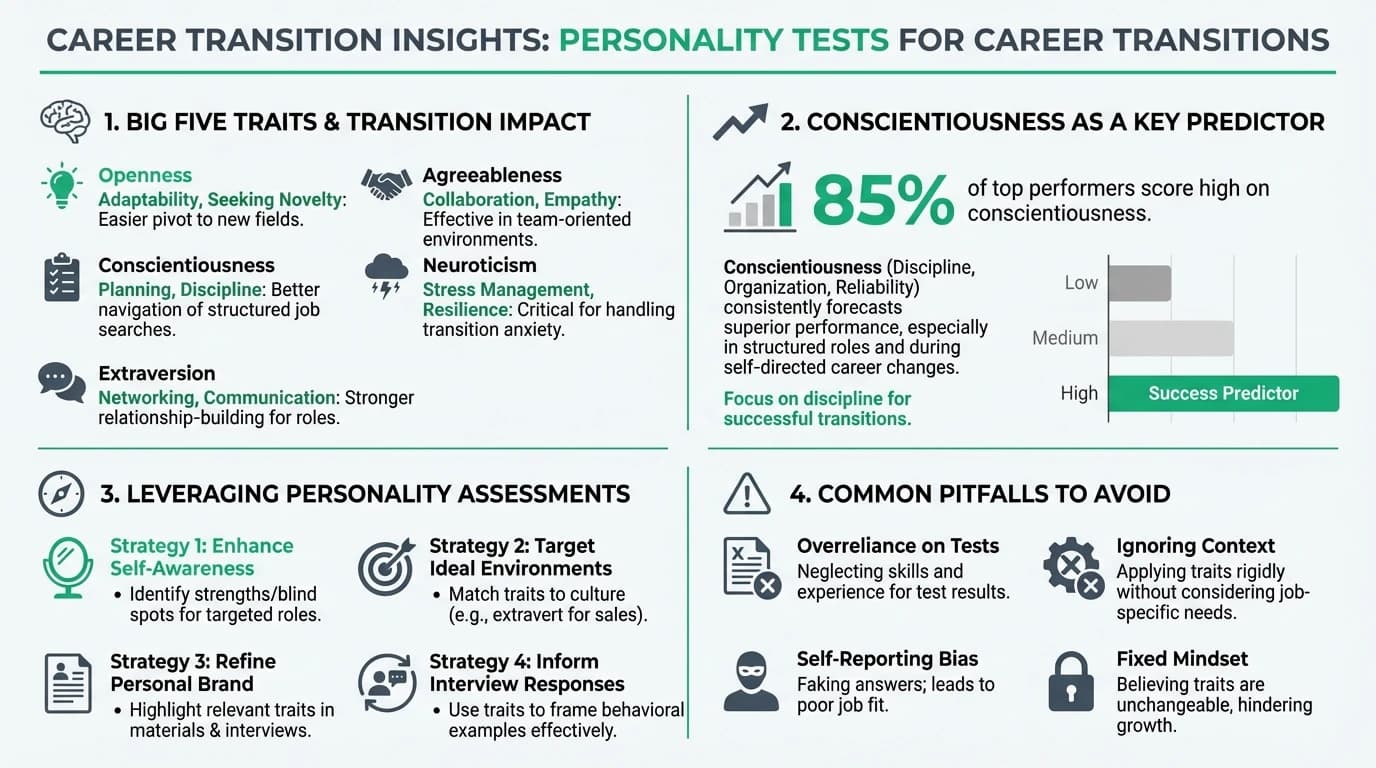
The Big Five personality traits—Conscientiousness, Openness, Extraversion, Agreeableness, and Neuroticism—are widely used in career assessments. Each trait provides insights into how individuals may perform and thrive in different career environments.
Big Five Traits Overview
| Trait | Description | Career Impact |
|---|---|---|
| Conscientiousness | Discipline and reliability | Predicts job success and training completion |
| Openness | Creativity and adaptability | Indicates flexibility and innovation potential |
| Extraversion | Sociability and assertiveness | Important for networking and leadership roles |
| Agreeableness | Cooperation and empathy | Affects teamwork and customer-facing roles |
| Neuroticism | Emotional stability | High levels can hinder career maturity |
How Personality Tests Aid Career Transitions
Personality assessments help mid-career changers by:
- Identifying Strengths: Highlighting traits like conscientiousness that predict success.
- Career Fit: Matching personality profiles with suitable roles.
- Pivoting Strategies: Developing strategies based on personality-driven insights.
Personality and Transition Success
| Transition Factor | Trait Influence | Example |
|---|---|---|
| Training Completion | High Conscientiousness | More likely to finish retraining programs |
| Job Placement | Extraversion | Easier networking and role attainment |
| Dropout Risk | High Neuroticism | Increased risk without support |
Conscientiousness: The Key Predictor
Conscientiousness is the strongest predictor of career transition success, influencing job placement and performance.
- Effect: Drives completion of vocational training.
- Process: Enhances follow-through and reliability.
- Caveat: Alone, it doesn't guarantee role fit.
Openness and Career Flexibility
Openness to experience is crucial for adapting to new industries and roles.
- Effect: Encourages learning and innovation.
- Process: Facilitates transitions into creative or unconventional roles.
- Caveat: May require balancing with practical skills.
Extraversion and Networking
Extraversion aids in securing new positions and excelling in client-facing or leadership roles.
- Effect: Boosts networking capabilities.
- Process: Enhances visibility and influence in new roles.
- Caveat: Introverts may need targeted strategies.
Neuroticism: A Transition Risk
High neuroticism can negatively impact career transitions by increasing dropout risks and reducing career maturity.
- Effect: Predicts emotional instability.
- Process: May require additional support and coaching.
- Caveat: Address through mental health resources.
Agreeableness and Workplace Fit
While agreeableness can enhance teamwork, it may pose challenges in competitive environments.
- Effect: Improves collaboration.
- Process: Facilitates positive workplace relationships.
- Caveat: May need assertiveness training for leadership roles.
Transferable Strengths Identification
Personality tests help articulate transferable skills, essential for resumes and interviews.
Transferable Skills by Trait
| Trait | Strength | Skill | Applicable Roles |
|---|---|---|---|
| Conscientiousness | Reliability | Project Management | Operations, Engineering |
| Openness | Creativity | Innovation | Tech, R&D |
| Extraversion | Communication | Sales | Sales, Management |
| Agreeableness | Empathy | Customer Service | HR, Healthcare |
Personality Tests vs. Traditional Assessments
Personality assessments offer unique insights beyond traditional career tools.
- Advantage: Capture socio-emotional skills.
- Combination: Use with skills assessments for a holistic view.
- Caveat: Not a standalone solution.
Employer Perception and Selection Bias
Employers often favor traits like conscientiousness and emotional stability, influencing hiring decisions.
- Effect: Traits signal reliability and adaptability.
- Strategy: Highlight these traits in applications and interviews.
Action checklist
- Take a Big Five personality test.
- Identify your top strengths and potential barriers.
- Align career goals with personality insights.
- Develop a personalized career pivot strategy.
FAQ
What is the Big Five personality test?
How can personality tests help in career transitions?
Are personality tests reliable for career planning?
What if my personality doesn't match my desired career?
How do employers use personality traits in hiring?
Can personality traits change over time?
What should I do if I'm high in neuroticism?
Primary Sources
| Source | Type | URL |
|---|---|---|
| NIH/PMC | Peer-reviewed research | source |
| Akademia Baru | Peer-reviewed research | source |
Conclusion
Personality tests like the Big Five provide valuable insights into career transitions, helping mid-career professionals identify strengths and align with suitable roles. By combining these assessments with other tools, individuals can develop effective pivoting strategies.