personality-tests
Big Five Traits and Retirement Transition
Explore how the Big Five personality traits shape retirement planning, adjustment, and life satisfaction with evidence from longitudinal research.
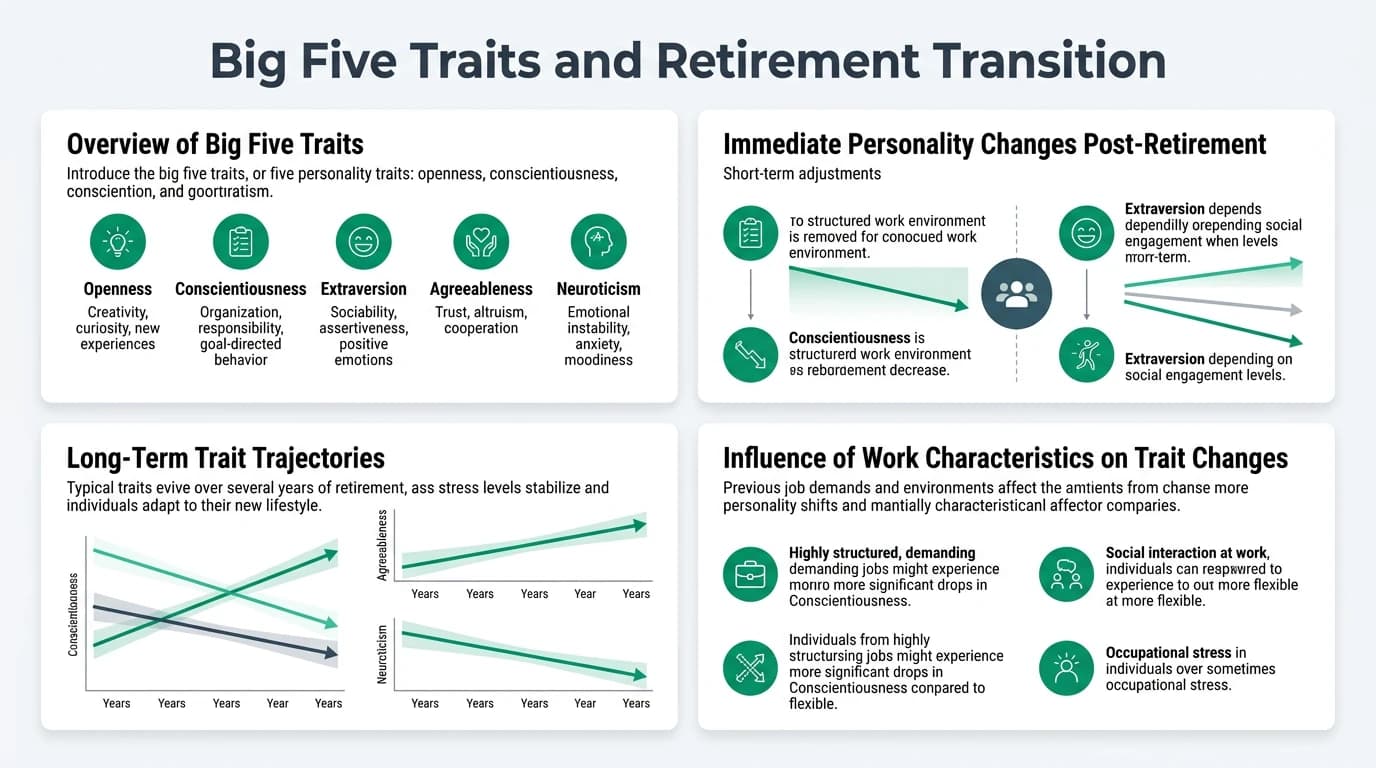
Quick answer
How do Big Five personality traits affect retirement transition?
The Big Five traits predict retirement timing, adjustment quality, and post-retirement life satisfaction. Conscientiousness predicts earlier voluntary retirement and better planning. Neuroticism predicts delayed retirement and greater adjustment difficulty. Openness and agreeableness show temporary increases immediately post-retirement.
Source: Schwaba & Bleidorn (2019), Journal of Personality and Social Psychology
Executive Summary
Retirement is one of the most significant life transitions adults face. It reshapes daily routines, social networks, identity, and financial security. Research from longitudinal studies — including SOEP, MIDUS, and HRS — consistently shows that Big Five personality traits predict both how people approach retirement and how well they adjust afterward12.
The bottom line: Personality is not destiny, but it is a powerful predictor. Understanding your Big Five profile before retirement enables targeted planning that addresses your specific vulnerabilities and leverages your natural strengths.
- Openness and agreeableness show a sudden increase in the first month post-retirement before gradually declining2.
- Conscientiousness and extraversion remain stable through the transition2.
- Neuroticism predicts greater difficulty with adjustment and lower life satisfaction3.
Critical Warning: Failing to account for personality-driven adjustment differences leads to generic retirement advice that works for some profiles but harms others.
What Are the Big Five Personality Traits?
The Big Five model (Five-Factor Model or OCEAN) is the most empirically validated personality framework, supported by decades of cross-cultural research. Each trait represents a spectrum rather than a fixed category4.
- Openness to Experience: Intellectual curiosity, creativity, and preference for novelty.
- Conscientiousness: Organization, self-discipline, and goal-directed behavior.
- Extraversion: Social energy, assertiveness, and enthusiasm.
- Agreeableness: Warmth, cooperation, and trust in others.
- Neuroticism: Emotional instability, anxiety, and stress reactivity.
| Trait | High-Scorer Retirement Behavior | Low-Scorer Retirement Behavior | Key Challenge |
|---|---|---|---|
| Openness | Pursues new hobbies, travel, learning | Prefers familiar routines, resists change | Sustaining novelty after initial excitement |
| Conscientiousness | Plans early, budgets carefully, sets goals | Approaches retirement without structure | Avoiding rigidity and over-planning |
| Extraversion | Builds active social calendar | Enjoys solitude, smaller social circles | Maintaining energy without work-based social networks |
| Agreeableness | Volunteers, nurtures relationships | Independent, selective about commitments | Setting boundaries to avoid over-commitment |
| Neuroticism | Worries about finances, health, purpose | Adjusts calmly, views retirement positively | Managing anxiety without workplace distraction |
For a comprehensive overview of trait changes across life stages, see our guide on personality changes across the lifespan.
Personality Changes Immediately After Retirement
One of the most striking findings from retirement personality research comes from Schwaba and Bleidorn (2019), who tracked personality changes in over 500 German retirees using the Socio-Economic Panel (SOEP) dataset. They found sudden, measurable shifts in two traits immediately following retirement2.
- Openness: Increases sharply in the first month post-retirement as individuals explore new possibilities.
- Agreeableness: Rises temporarily, likely reflecting reduced workplace competition and stress.
- Conscientiousness and Extraversion: Remain stable through the transition.
- Emotional Stability: Shows a steady increase (i.e., neuroticism decreases) over time2.
| Trait | Pre-Retirement Trend | Month 1 Post-Retirement | 5-Year Post-Retirement Trend |
|---|---|---|---|
| Openness | Stable | Significant increase | Gradual decline back toward baseline |
| Agreeableness | Stable | Significant increase | Gradual decline back toward baseline |
| Conscientiousness | Stable | No change | Stable |
| Extraversion | Stable | No change | Stable |
| Emotional Stability | Gradual increase | Continued increase | Continued increase |
Why These Changes Happen
The initial spikes in openness and agreeableness reflect the psychological "honeymoon phase" of retirement. Freed from work demands, individuals temporarily become more exploratory and cooperative. As the novelty fades and new routines form, these traits trend back toward pre-retirement levels2.
- The absence of workplace stressors allows natural agreeableness to emerge.
- New free time initially triggers exploration (openness), but routine gradually returns.
- The decline is not a sign of failure — it represents normal personality equilibrium restoration.
Long-Term Trait Trajectories in Retirement
Looking beyond the first months, personality trajectories across five or more years of retirement reveal patterns that matter for long-term planning12.
- Emotional stability continues to improve, meaning retirees generally become less anxious over time.
- The initial openness spike fades, making it critical to establish new activities during the honeymoon period.
- Individual variability is large — some retirees experience different patterns depending on pre-retirement work characteristics1.
| Timeframe | Openness | Agreeableness | Conscientiousness | Extraversion | Emotional Stability |
|---|---|---|---|---|---|
| 5 years pre-retirement | Stable | Stable | Stable | Stable | Increasing slightly |
| Retirement month | Peak | Peak | Unchanged | Unchanged | Increasing |
| 1 year post | Declining from peak | Declining from peak | Unchanged | Unchanged | Increasing |
| 5 years post | Near baseline | Near baseline | Unchanged | Unchanged | Highest |
| Life Satisfaction Predictor | Direction of Effect | Strength of Evidence | Practical Implication |
|---|---|---|---|
| Emotional stability (low neuroticism) | Strong positive | Very strong (MIDUS, SOEP, HRS) | Invest in anxiety management pre-retirement |
| Conscientiousness | Moderate positive | Strong | Plan structured daily routines |
| Extraversion | Moderate positive | Moderate | Maintain active social networks |
| Openness | Moderate positive (early) | Moderate | Capitalize on the honeymoon exploration phase |
| Agreeableness | Weak positive | Moderate | Engage in volunteer and community activities |
How Work Characteristics Modify Trait Changes
Not everyone experiences the same personality shifts in retirement. Pre-retirement work characteristics — particularly job autonomy and skill discretion — moderate how traits change after leaving the workforce1.
- Workers with high job autonomy show smaller declines in openness post-retirement.
- Those with low autonomy may experience larger neuroticism reductions (removal of a stressor).
- Skill discretion at work predicts the magnitude of openness changes1.
| Work Characteristic | Neuroticism Change | Openness Change | Extraversion Change |
|---|---|---|---|
| High autonomy | Moderate decline | Small decline | Stable |
| Low autonomy | Large decline | Moderate decline | Slight decline |
| High skill discretion | Moderate decline | Small decline | Stable |
| Low skill discretion | Moderate decline | Larger decline | Slight decline |
Implications for Pre-Retirement Planning
- If your job was highly autonomous, retirement may feel less disruptive to your personality.
- If your job had low autonomy, expect a more noticeable personality "rebound" as you gain freedom.
- Plan replacement activities that match the level of challenge your work provided.
Big Five Traits as Predictors of Retirement Timing
Personality traits influence not just how people adjust to retirement but when they choose to retire. A large European study by Lucifora and Ferrante (2022) examined how the Big Five predict retirement decisions across age groups 50 to 803.
- High neuroticism predicts delayed retirement due to financial anxiety and loss-of-purpose fears.
- High conscientiousness predicts earlier planned retirement — conscientious individuals prepare better and reach readiness sooner.
- Indirect effects through job characteristics mediate some personality-retirement timing relationships5.
| Age Group | High Neuroticism Effect | High Conscientiousness Effect | High Openness Effect |
|---|---|---|---|
| 50-60 | Delays retirement | Predicts planned early retirement | Slightly earlier retirement |
| 60-70 | Continues delaying | Supports well-timed transition | Neutral |
| 70-80 | Strong delay (fear-based) | Rarely applicable (already retired) | Neutral |
| Retirement Decision Factor | Personality Influence | Mechanism |
|---|---|---|
| Financial readiness | Conscientiousness (positive) | Better savings behavior and planning |
| Fear of boredom | Openness (reduces fear) | Sees opportunities in free time |
| Identity loss anxiety | Neuroticism (increases fear) | Catastrophizes about losing professional identity |
| Social network concerns | Extraversion (increases concern) | Worried about losing work-based social ties |
For related strategies on managing work-life transitions, see our work-life balance guide.
Neuroticism and Stress Reactivity in Retirement
High neuroticism remains a risk factor for poor retirement outcomes, but not in the way most people assume. A 10-year study using the MIDUS dataset found that neuroticism has significant main effects on depression and physical health — but does not strongly moderate the impact of stressful life events3.
- Neuroticism predicts baseline levels of depressive symptoms independently of specific stressors.
- Family, financial, and health stressors affect all retirees, but neurotic retirees start from a higher anxiety baseline.
- Targeted coping interventions can buffer neuroticism's impact on retirement well-being3.
| Stressor Domain | Impact on Depression | Impact on Physical Health | Neuroticism Moderation |
|---|---|---|---|
| Family stress | Moderate | Moderate | Not significant |
| Financial stress | Moderate to high | Moderate | Not significant |
| Health decline | High | High | Not significant |
| Social isolation | Moderate | Low to moderate | Not significant |
Practical Strategies for High-Neuroticism Retirees
- Build a financial buffer: Extra savings reduce the anxiety trigger of financial uncertainty.
- Establish health routines early: Proactive health management reduces catastrophic health thinking.
- Maintain therapeutic support: Continued access to counseling or therapy during the transition.
- Create daily structure: Unstructured time amplifies neurotic rumination.
Explore our stress management and coping strategies guide for evidence-based interventions.
Extraversion and Social Adjustment in Retirement
Extraversion does not change significantly during the retirement transition, but its role in adjustment becomes critical as work-based social networks dissolve2.
- Extraverted retirees face the challenge of replacing the social stimulation that work provided.
- They benefit most from group activities, community organizations, and social hobbies.
- Introverted retirees may adapt more easily to the quieter pace of retirement but risk social isolation.
| Social Strategy | Best for Extraverts | Best for Introverts |
|---|---|---|
| Community volunteering | High energy, social fulfillment | Structured, meaningful contribution |
| Group exercise classes | Social interaction plus health | Routine-based, low social pressure |
| Book clubs or study groups | Intellectual discussion | Deep, focused conversation |
| Part-time consulting | Professional identity maintenance | Flexible, project-based engagement |
For insights on maintaining friendships during life transitions, explore our friendship and social relationships guide.
Conscientiousness and Retirement Planning Quality
Conscientiousness is the single strongest personality predictor of retirement planning quality. Conscientious individuals start planning earlier, save more consistently, and set more specific post-retirement goals5.
- They are more likely to have diversified savings, updated estate plans, and healthcare directives.
- Their structured approach reduces uncertainty — the primary driver of retirement anxiety.
- However, overly rigid planning can become a liability when unexpected changes occur.
| Planning Dimension | High Conscientiousness | Low Conscientiousness | Risk |
|---|---|---|---|
| Financial preparation | Detailed budgets, diversified savings | Minimal savings, vague plans | Financial insecurity |
| Healthcare planning | Advance directives, insurance reviewed | Deferred, unplanned | Medical decision stress |
| Activity planning | Structured weekly schedules | No plan, reactive | Boredom and purposelessness |
| Social planning | Maintained relationships, scheduled activities | Assumed friendships will persist | Social isolation |
For more on conscientiousness as a trait, see our conscientiousness complete guide.
Openness and Post-Retirement Growth Opportunities
The temporary spike in openness immediately after retirement creates a unique window for personal growth. Research suggests this is the optimal time to try new activities, travel, or pursue lifelong learning goals2.
- The first 3 to 6 months post-retirement represent the peak of this openness window.
- Activities initiated during this period are more likely to become lasting habits.
- After the openness spike fades, inertia makes it harder to start new pursuits.
| Growth Opportunity | Timing (Months Post-Retirement) | Openness Requirement | Sustainability |
|---|---|---|---|
| New hobby (art, music, language) | 1-3 | Moderate | High if started early |
| Travel or relocation | 1-6 | High | Variable |
| Volunteer work | 1-3 | Low to moderate | Very high |
| Part-time education | 3-6 | High | Moderate |
| Mentoring or coaching | 1-6 | Moderate | High |
Health Outcomes and Personality in Retirement
Big Five traits influence physical and mental health outcomes throughout retirement, though the mechanisms are primarily through main effects rather than stress moderation3.
- Neuroticism predicts higher rates of depression and lower self-rated health in retirement.
- Conscientiousness predicts better health behaviors (exercise, medication adherence, preventive care).
- Extraversion correlates with better mental health through social engagement.
- The combined effect of multiple traits creates distinct health risk profiles3.
| Health Outcome | Positive Trait Predictors | Negative Trait Predictors | Intervention Priority |
|---|---|---|---|
| Depression risk | Extraversion, Conscientiousness | Neuroticism | Screening and early intervention |
| Self-rated health | Conscientiousness, Openness | Neuroticism | Health behavior support |
| Social well-being | Extraversion, Agreeableness | Low Extraversion | Community integration programs |
| Cognitive decline risk | Openness, Conscientiousness | Low Openness | Intellectual stimulation activities |
Retirement Planning Roadmap by Personality Profile
Effective retirement planning should be personalized to your Big Five profile. The following roadmap adapts generic retirement advice to specific personality needs.
- Phase 1 (5 years pre-retirement): Assess personality and identify adjustment risks.
- Phase 2 (1-2 years pre-retirement): Design trait-matched activities and financial plans.
- Phase 3 (Month 1-6 post-retirement): Capitalize on the openness and agreeableness spike.
- Phase 4 (Year 1 and beyond): Monitor well-being and adjust plans based on actual experience.
| Profile | Pre-Retirement Focus | Transition Strategy | Post-Retirement Priority |
|---|---|---|---|
| High Neuroticism | Build financial buffer, start therapy | Gradual transition (part-time first) | Daily structure, ongoing support |
| High Conscientiousness | Set specific goals, create schedules | Execute prepared plan | Build in flexibility and spontaneity |
| High Extraversion | Map social networks beyond work | Join groups before retiring | Maintain high social activity level |
| High Openness | Research new interests, plan exploration | Try multiple new activities immediately | Commit to two or three lasting pursuits |
| High Agreeableness | Identify volunteer and community roles | Engage in service projects | Set boundaries on commitments |
Retirement transition action checklist
- Complete a Big Five personality assessment at least two years before planned retirement.
- Identify your top two personality-based adjustment risks.
- Create a financial plan that includes a buffer for the first year of uncertainty.
- Map your current social network and identify work-dependent relationships at risk.
- Plan at least three new activities to try in the first three months post-retirement.
- If high in neuroticism, establish therapeutic support before transitioning.
- Set quarterly check-ins with a trusted friend or advisor to monitor adjustment.
- Review and revise your retirement plan at six months and twelve months post-retirement.
FAQ
Do personality traits change after retirement?
Yes, but selectively. Schwaba and Bleidorn (2019) found that openness and agreeableness increase sharply in the first month post-retirement before gradually declining over five years. Conscientiousness and extraversion remain stable. Emotional stability (the inverse of neuroticism) shows a steady, long-term increase. Source: Schwaba & Bleidorn, 2019
Which personality trait best predicts retirement planning quality?
Conscientiousness is the strongest predictor of retirement planning quality. Conscientious individuals start planning earlier, save more consistently, and set more specific goals. This results in lower financial anxiety and smoother adjustment during the transition. Source: Lucifora & Ferrante, 2022
Does neuroticism make retirement adjustment harder?
Yes. High neuroticism predicts greater anxiety about financial security, identity loss, and health decline in retirement. However, research shows that neuroticism does not strongly moderate the impact of specific stressful events — rather, it elevates baseline distress levels that persist regardless of circumstances. Targeted interventions (therapy, financial buffers, daily structure) can effectively mitigate these effects. Source: MIDUS Study, Oxford Academic
How does pre-retirement job type affect personality changes?
Workers with high job autonomy and skill discretion show smaller personality changes post-retirement — their openness declines less and neuroticism drops less dramatically. Workers from low-autonomy, low-discretion jobs often experience a larger "personality rebound" as workplace constraints are removed. Source: MIDUS Study
Is there an optimal time to start new activities after retirement?
Yes. The first three to six months post-retirement represent a window of heightened openness — the best time to initiate new hobbies, travel, or learning. Activities started during this period are more likely to become lasting habits. After the openness spike fades, inertia makes it significantly harder to begin new pursuits. Source: Schwaba & Bleidorn, 2019
How can extraverts maintain social fulfillment after retiring?
Extraverts should proactively build social networks outside of work before retiring. Joining community organizations, group exercise classes, volunteer teams, or part-time consulting keeps social stimulation high. The key is replacing work-provided social interaction with equivalent-energy alternatives. Source: MIDUS Study
Can personality assessments help with retirement planning?
Absolutely. Tools like the NEO-PI-R or Big Five Inventory can identify specific traits that predict adjustment challenges — such as high neuroticism for anxiety risk or low openness for boredom risk. Many retirement coaches and financial planners now incorporate personality assessments into their planning process. Source: American Psychological Association
What longitudinal studies inform personality-retirement research?
The major studies include SOEP (German Socio-Economic Panel), MIDUS (Midlife in the United States), HRS (Health and Retirement Study), and the SHARE study in Europe. These multi-wave datasets track thousands of individuals over decades, providing robust evidence on personality-retirement dynamics. Source: Schwaba & Bleidorn, 2019
Notes
Primary Sources
| Source | Type | URL |
|---|---|---|
| MIDUS (University of Wisconsin) | Longitudinal Study | Link |
| Schwaba & Bleidorn (2019) — JPSP | Journal Article | Link |
| Sutin, Stephan, & Terracciano (2020) — Oxford Academic | Journal Article | Link |
| Lucifora & Ferrante (2022) — Labour | Journal Article | Link |
| American Psychological Association — Personality | Official Resource | Link |
Conclusion
Retirement is not a single event — it is a multi-year psychological transition shaped by the personality traits you bring into it. The Big Five framework reveals that conscientiousness drives superior planning, neuroticism predicts adjustment challenges, and the temporary openness spike after retirement creates a unique window for personal growth.
The most important step you can take is self-awareness. Assess your Big Five profile, identify your specific risks and opportunities, and design a retirement plan that works with — not against — your personality. The research is clear: personality-informed retirement planning produces better outcomes in satisfaction, health, and purpose.
Footnotes
-
University of Wisconsin. "MIDUS: Personality and Life Transitions." Midlife in the United States Study. Available at: https://midus.wisc.edu/wp-content/uploads/2024/04/3102.pdf ↩ ↩2 ↩3 ↩4 ↩5
-
Schwaba, T. & Bleidorn, W. (2019). "Personality Trait Development Across the Transition to Retirement." Journal of Personality and Social Psychology, 116(4), 651-665. Available at: https://pubmed.ncbi.nlm.nih.gov/29376664/ ↩ ↩2 ↩3 ↩4 ↩5 ↩6 ↩7 ↩8 ↩9
-
Sutin, A. R., Stephan, Y., & Terracciano, A. (2020). "Neuroticism, Stressful Life Events, and Health Outcomes." The Journals of Gerontology: Series B, 76(1), 44-54. Available at: https://academic.oup.com/psychsocgerontology/article/76/1/44/5849472 ↩ ↩2 ↩3 ↩4 ↩5 ↩6
-
Roberts, B. W., Walton, K. E., & Viechtbauer, W. (2006). "Patterns of Mean-Level Change in Personality Traits Across the Life Course." Psychological Bulletin, 132(1), 1-25. Available at: https://doi.org/10.1037/0033-2909.132.1.1 ↩
-
Lucifora, C. & Ferrante, F. (2022). "Personality Traits and Retirement Decisions." Labour, 36(1), 1-28. Available at: https://onlinelibrary.wiley.com/doi/abs/10.1111/labr.12210 ↩ ↩2