personal-development
Personality Optimism Big Five
Practical guide to understand and apply Personality Optimism Big Five.
md
title: "Personality and Optimism: How Big Five Traits Shape Your Outlook" description: "Explore how the Big Five personality traits influence optimism and pessimism. Learn who sees the glass half full and what research says about shaping your mindset." slug: "personality-optimism-big-five" category: "personal-development" keywords: ["Big Five personality traits optimism", "how does personality affect optimism", "emotional stability and optimism", "extraversion and positive outlook", "realistic optimism personality"] author: "Editorial Team" datePublished: "2026-03-19" lastUpdated: "2026-03-19" featured: true images:
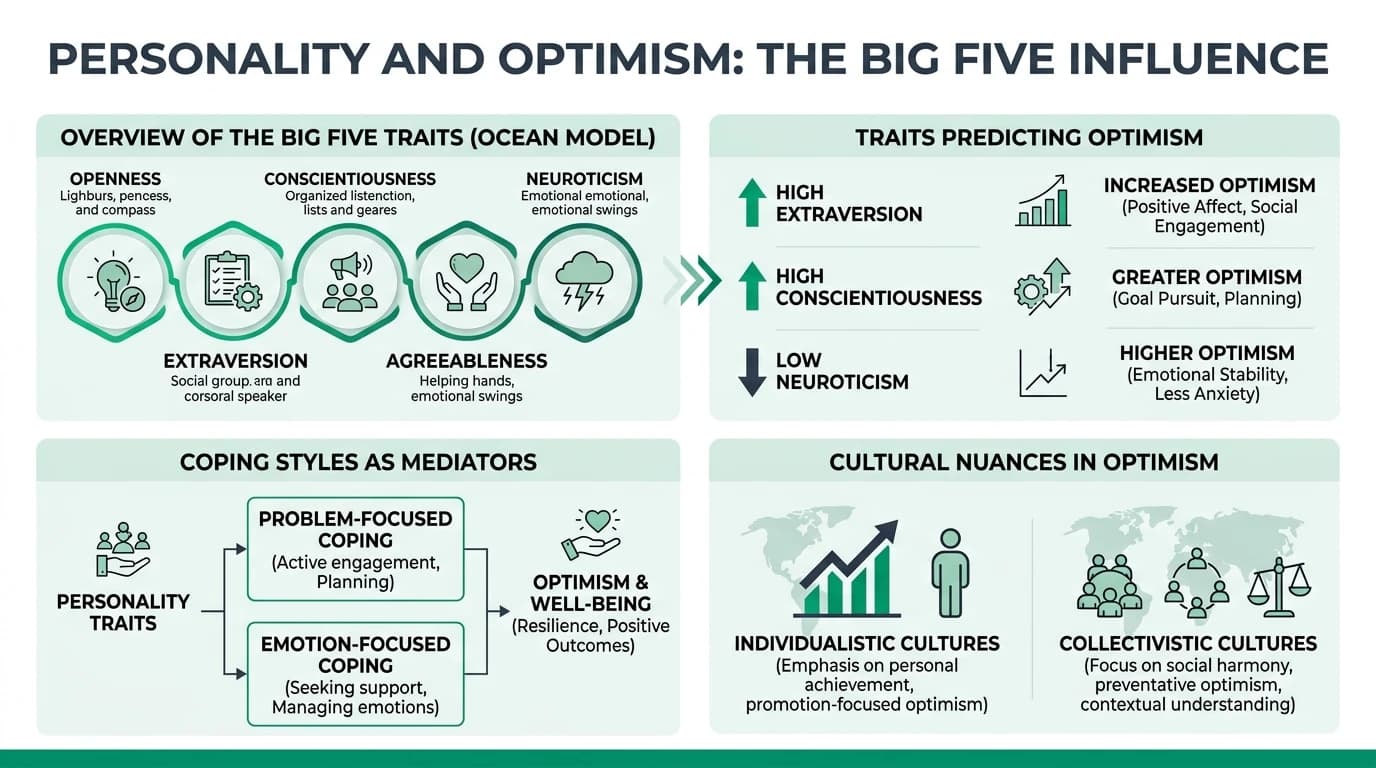
- url: "/images/guides/personality-optimism-big-five.webp" alt: "Illustration showing different personality traits represented by diverse individuals with varying outlooks on life." caption: "Understanding how personality traits influence optimism can help improve your outlook and well-being." relatedGuides:
- "neuroticism-complete-guide-big-five"
- "personality-resilience-mental-toughness-big-five"
- "personality-stress-management-coping-strategies"
Quick answer
How do Big Five personality traits affect optimism?
Certain traits like emotional stability, extraversion, and conscientiousness are linked to a more optimistic outlook, while high neuroticism often correlates with pessimism.
Source: Nishaat, 2025
Executive Summary
- Optimism and personality: The Big Five traits—especially emotional stability, extraversion, and conscientiousness—play a key role in shaping whether we see the glass as half full or half empty.
- Cultural nuances: While extraversion boosts optimism in Western contexts, this link is weaker in non-Western cultures like India.
- Actionable insights: Understanding your personality can guide you in adopting strategies to cultivate a more optimistic outlook.
The bottom line: Your personality traits significantly influence your optimism, but with the right strategies, you can foster a more positive mindset.
Critical Warning: This article is for informational purposes only and does not replace professional mental health advice.
What is Optimism?
Optimism is a hopeful, positive outlook on life. It involves expecting good things to happen and seeing challenges as opportunities rather than threats.
Realistic vs. Naive Optimism
| Dimension | Realistic Optimism | Naive Optimism |
|---|---|---|
| Future Outlook | Balanced and hopeful | Overly positive |
| Challenge Acknowledgment | Recognizes difficulties | Ignores potential issues |
| Coping Strategy | Problem-solving | Avoidance |
Key takeaway: Realistic optimism balances hope with practical awareness, avoiding the pitfalls of naive positivity.
How Do the Big Five Traits Influence Optimism?
The Big Five personality traits—Openness, Conscientiousness, Extraversion, Agreeableness, and Neuroticism (OCEAN)—are foundational in understanding optimism.
Big Five Traits Overview
| Trait | Description | Influence on Optimism |
|---|---|---|
| Openness | Creativity and openness to new experiences | Encourages adaptive thinking |
| Conscientiousness | Discipline and goal-oriented behavior | Supports problem-solving |
| Extraversion | Sociability and positive emotionality | Boosts social support |
| Agreeableness | Cooperation and trust | Enhances interpersonal optimism |
| Neuroticism | Emotional instability | Often linked to pessimism |
Important: Emotional stability (low neuroticism) is the strongest predictor of optimism.
Emotional Stability: The Optimism Anchor
Emotional stability refers to low levels of anxiety and depression. It's the strongest predictor of an optimistic outlook.
Why It Matters
- Effect: Stable emotions support resilience.
- Process: Encourages positive emotional regulation.
- Caveat: High neuroticism can lead to catastrophizing.
Practical Tips:
- Practice mindfulness to enhance emotional regulation.
- Engage in activities that boost mood and reduce stress.
Extraversion and Positive Affect
Extraversion involves being outgoing and energetic. It often leads to a more positive outlook due to increased social support and positive emotionality.
Cultural Variations
| Context | Extraversion-Optimism Link |
|---|---|
| Western | Strong correlation |
| Non-Western (e.g., India) | Weaker correlation |
Key takeaway: Cultural context can influence how extraversion affects optimism.
Conscientiousness, Goal-Setting, and Self-Efficacy
Conscientiousness involves being organized and goal-focused. It predicts optimism through effective planning and a sense of control.
How It Works
- Goal-Setting: Encourages proactive problem-solving.
- Self-Efficacy: Builds confidence in achieving goals.
Practical Tips:
- Set clear, achievable goals.
- Use planning tools to stay organized.
Agreeableness and Interpersonal Optimism
Agreeableness is about being cooperative and trusting. It supports optimism by fostering positive relationships and collaborative problem-solving.
Benefits
- Trust: Builds strong, supportive networks.
- Cooperation: Enhances group problem-solving.
Practical Tips:
- Practice active listening to improve relationships.
- Engage in community activities to build trust.
Openness to Experience and Cognitive Flexibility
Openness involves being open to new experiences and ideas. It supports optimism by encouraging flexible thinking and creativity.
How It Helps
- Adaptive Thinking: Reframes challenges as opportunities.
- Creativity: Promotes innovative solutions.
Practical Tips:
- Explore new hobbies to boost creativity.
- Challenge your assumptions regularly.
Coping Styles as the Mechanism
Coping styles mediate the relationship between personality and optimism. Problem-focused coping is particularly effective.
Coping Styles
| Personality Type | Preferred Coping Style | Optimism Outcome |
|---|---|---|
| High Conscientiousness | Problem-focused | Increased optimism |
| High Extraversion | Social support-seeking | Enhanced resilience |
Important: Choose coping strategies that align with your personality for better outcomes.
Can You Become More Optimistic?
Yes, optimism can be developed through intentional strategies and interventions.
Interventions
- Cognitive Reframing: Change negative thought patterns.
- Problem-Focused Coping: Tackle challenges head-on.
- Mindfulness Practices: Enhance emotional regulation.
Practical Tips:
- Attend workshops on positive thinking.
- Work with a coach or therapist to develop optimism.
Real-World Applications
Understanding the personality-optimism link can help in various life areas.
Scenarios
- Career Transition: Use personality insights to manage anxiety.
- Mental Health Recovery: Apply optimism-building strategies.
- Relationship Dynamics: Improve communication with personality awareness.
Action checklist
- Identify your Big Five personality traits.
- Choose coping strategies that align with your traits.
- Practice cognitive reframing to boost optimism.
FAQ
Can you change your personality to become more optimistic?
What is the difference between optimism and extraversion?
Does neuroticism always lead to pessimism?
Which Big Five trait is most important for happiness?
Is optimism genetic or learned?
How does culture affect the personality-optimism link?
Can pessimistic people become optimistic?
Notes
Primary Sources
| Source | Type | URL |
|---|---|---|
| Nishaat, A. | Peer-reviewed conference paper | IAFOR |
| INPACT Psychology Conference | Peer-reviewed conference proceedings | INPACT |
Conclusion
Understanding how your personality influences optimism can empower you to adopt strategies that enhance your outlook and well-being. By aligning your coping mechanisms with your personality traits, you can cultivate a more positive and resilient mindset.