lifestyle
Personality and Environmental Behavior: Big Five Traits, Pro-Environmental Attitudes, Sustainable Consumption, and Climate Action Research
Explore how the Big Five personality traits influence pro-environmental attitudes, sustainable consumption, and climate action.
Quick answer
Which Big Five traits predict pro-environmental attitudes?
Openness, Agreeableness, and Conscientiousness are the strongest predictors of pro-environmental attitudes.
Source: University of Edinburgh
Executive Summary
Ever wondered how your personality might influence your environmental choices? Research shows that certain traits from the Big Five personality model—Openness, Agreeableness, and Conscientiousness—are linked to stronger pro-environmental attitudes and behaviors. This insight can help individuals and policymakers promote sustainable living.
The bottom line: Understanding your personality can guide you toward more eco-friendly habits.
Critical Warning: Correlations do not imply causation. Individual differences can vary widely.
What Are the Big Five Traits?
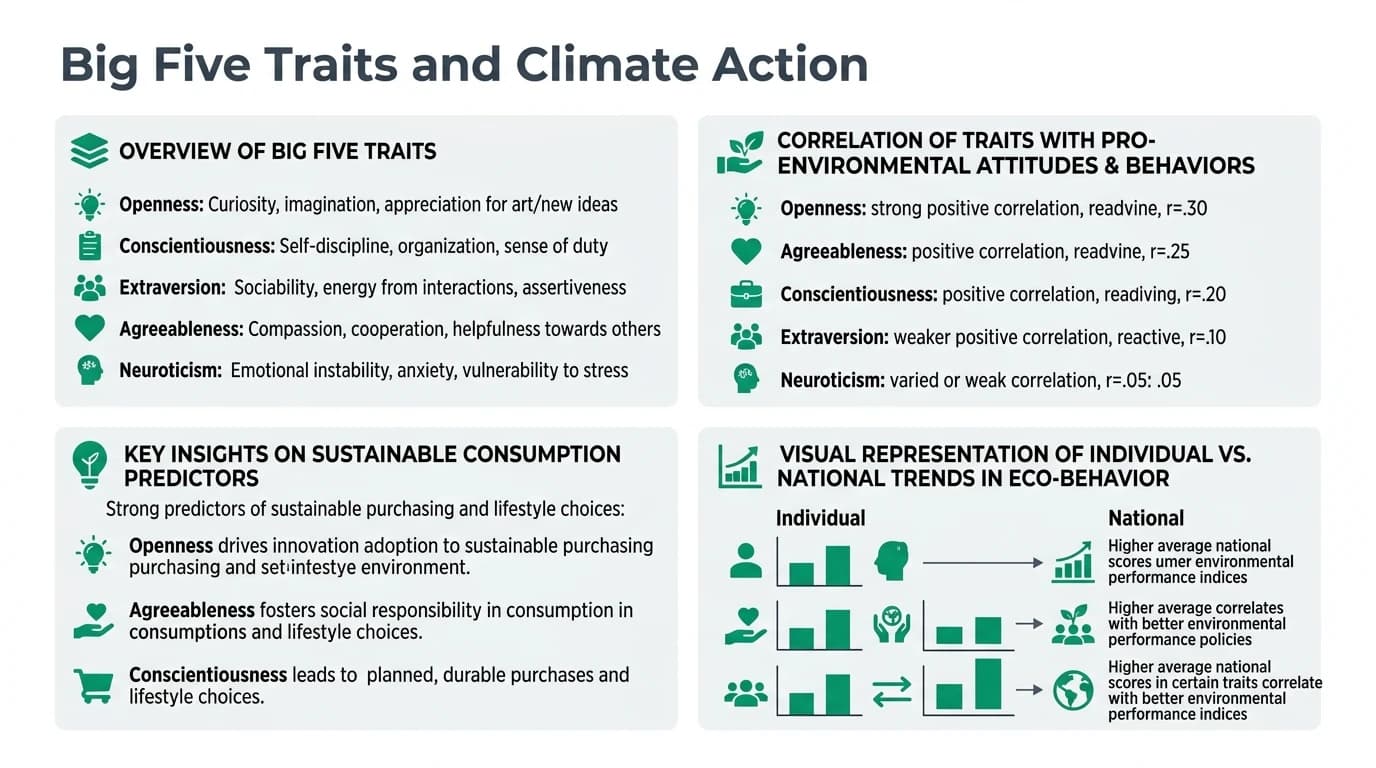
The Big Five personality traits are a well-known model in psychology:
- Openness: Creativity and curiosity.
- Conscientiousness: Organization and responsibility.
- Extraversion: Sociability and energy.
- Agreeableness: Compassion and cooperation.
- Neuroticism: Emotional instability.
Key Takeaways:
- Openness: Linked to environmental concern.
- Conscientiousness: Predicts responsible consumption.
- Agreeableness: Encourages cooperative climate action.
How Do These Traits Influence Environmental Behavior?
Big Five vs. Pro-Environmental Strength
| Trait | Attitudes Correlation (r) | Behaviors Correlation (r) | Key Studies |
|---|---|---|---|
| Openness | .22 | .21 | [2] |
| Conscientiousness | .20 | .25 | [5] |
| Agreeableness | .18 | .22 | [6] |
Important: High Openness, Agreeableness, and Conscientiousness are consistently linked to pro-environmental attitudes.
Why Is Openness Important for Sustainability?
- Effect: Openness drives curiosity about environmental issues.
- Process: Leads to greater awareness and concern.
- Caveat: Low Openness can be a barrier to eco-friendly behavior.
Openness and Pro-Environmental Attitudes
| Aspect | Influence | Example |
|---|---|---|
| Curiosity | Drives learning | Seeking information on climate change |
| Creativity | Inspires innovative solutions | Designing sustainable products |
What Role Does Conscientiousness Play?
Conscientious individuals often adhere to environmental norms and regulations.
Conscientiousness in Sustainable Consumption
| Aspect | Influence | Example |
|---|---|---|
| Rule adherence | Supports plastic reduction | Following recycling guidelines |
| Responsibility | Encourages eco-friendly habits | Using public transport |
Key Takeaways:
- Conscientiousness: Strong predictor of sustainable actions.
- Moderation: Education can enhance these effects.
How Does Agreeableness Affect Climate Cooperation?
Agreeable people tend to prioritize cooperation and altruism, fostering a collective approach to environmental issues.
Agreeableness and Climate Cooperation
| Aspect | Influence | Example |
|---|---|---|
| Altruism | Promotes green choices | Participating in community clean-ups |
| Cooperation | Encourages group efforts | Supporting local sustainability initiatives |
Can Extraversion Lead to Eco-Friendly Actions?
Extraverts may engage more in group-based sustainability efforts, though their impact varies by context.
Extraversion's Variable Effects
| Aspect | Influence | Example |
|---|---|---|
| Sociability | Boosts group actions | Organizing eco-events |
| Energy | Drives active participation | Joining environmental campaigns |
Important: Extraversion's impact is context-dependent.
How Does Neuroticism Influence Environmental Engagement?
Lower levels of Neuroticism can enhance emotional stability, aiding in consistent pro-environmental behavior.
Neuroticism's Inverse Role
| Aspect | Influence | Example |
|---|---|---|
| Emotional Stability | Supports consistent actions | Regular recycling habits |
| Stress Reduction | Encourages participation | Engaging in stress-free eco-activities |
Individual vs. National-Level Trends
Research shows that the influence of personality traits on environmental behavior is consistent across individual and national levels.
Cross-Cultural Benchmarks
| Database Type | Key Traits | Findings |
|---|---|---|
| Objective indicators | Openness, Agreeableness | Strong both individually and nationally |
| Subjective attitudes | Conscientiousness | Consistent across cultures |
Key Takeaways:
- Consistency: Traits predict behaviors across different cultures.
- Application: Useful for global policy strategies.
FAQ
Which Big Five trait is most linked to pro-environmental behavior?
How does Openness to experience affect climate action?
Does Conscientiousness predict sustainable consumption habits?
Why is Agreeableness associated with environmental values?
Can Extraversion lead to more eco-friendly actions?
How does Neuroticism influence environmental engagement?
Are Big Five traits consistent predictors across countries?
Notes
Primary Sources
| Source | Type | URL |
|---|---|---|
| Yale Environment Review | Academic summary | Link |
| University of Edinburgh | Peer-reviewed | Link |
Conclusion
Understanding the Big Five personality traits provides valuable insights into promoting sustainable behaviors. Traits like Openness, Conscientiousness, and Agreeableness are key drivers of pro-environmental attitudes and actions.